- Proof Of Intel
- Posts
- Circle & Sasai's African Power Move, Robinhood's $1.5B Self-Bet, and OpenAI Kills Sora — Deepfakes, Disney Dollars, and Drama!
Circle & Sasai's African Power Move, Robinhood's $1.5B Self-Bet, and OpenAI Kills Sora — Deepfakes, Disney Dollars, and Drama!
In this edition, Mochi unpacks stablecoins storming African payment corridors, Robinhood doubling down on itself in a brutal market, and OpenAI shutting down the internet's weirdest app — taking a billion-dollar Disney deal straight to the grave with it!

Mochi
March 25, 2026

Hey there, PoI readers! 💫
It's your favorite frozen slice of fintech wisdom, Mochi, back with another deliciously packed edition of Proof of Intel! Today's serving is chef's kiss — we've got Circle and Sasai teaming up to make cross-border payments across Africa actually bearable, Robinhood flexing its wallet with a bold $1.5B buyback despite a rough 2026 so far, and OpenAI's Sora dramatically exiting the chat after just six months — taking a billion-dollar Disney deal down with it. Grab your favorite beverage, get comfortable, and let's dive into the good stuff.
INTEL BRIEF
🟧 Circle partners with African fintech Sasai to bring USDC stablecoin payments to African cross-border transactions and remittances.
🟧 Robinhood approves a $1.5B share buyback as its stock hits 2026 lows amid broad market and geopolitical turbulence.
🟧 OpenAI is shutting down its AI video platform Sora just six months after launch, axing all video products and reportedly cancelling a $1 billion Disney deal in the process.
🟧 A deeper, quirkier look at why Sora was always the internet's weirdest app — and why its shutdown was arguably inevitable.
Circle and Sasai Want to Fix the Ridiculously Expensive Problem of Sending Money Across Africa
Circle is now partnering with Sasai Fintech to change that narrative by integrating USDC, the world's second-largest stablecoin, into Sasai's existing payments infrastructure across African markets.
The goal? Slash costs, speed up settlement times, and make cross-border remittances, enterprise payments, and mobile wallet services actually bearable. Circle's full-stack onchain platform will be plugged into Sasai's network, which already serves multiple African markets — so this isn't starting from scratch, it's more like giving an existing road a serious upgrade.
Here's the kicker — and it's a big one. The World Bank flagged that countries like Sierra Leone, Uganda, Angola, Botswana, and Zambia were hit with remittance costs exceeding 7% in 2023. The UN wants that number below 3% globally. Seven percent to send your own money. Mochi finds that deeply unsweet.
USDC currently sits at a ~$78.6 billion market cap, making it the second-largest stablecoin — behind only Tether's USDT at ~$184.1 billion. Circle CEO Jeremy Allaire has made it clear the company has its eyes firmly on high-growth emerging markets, while Cassava Technologies Chairman Strive Masiyiwa believes the integration could meaningfully expand digital financial access for everyday businesses and consumers.
Meanwhile, crypto adoption across Sub-Saharan Africa is absolutely cooking — up 52% in the 12 months through June 2025, with the region pulling in over $205 billion in onchain value, per Chainalysis. Nigeria alone accounted for $92 billion of that. Stablecoins are increasingly being seen as a faster, cheaper alternative to traditional transfers — and regulators are slowly catching up, with Ghana's SEC greenlighting 11 crypto platforms into a regulatory sandbox this year.
Africa isn't just warming up to crypto. It's building the stadium.
Circle x Sasai are integrating USDC into African payment corridors to cut remittance costs and settlement times.Remittance fees in parts of Sub-Saharan Africa exceed 7% — far above the UN's 3% global target.Crypto adoption in Sub-Saharan Africa surged 52% YoY, with stablecoins emerging as a preferred tool for cross-border payments.Robinhood Is Buying Back $1.5 Billion of Its Own Stock While Its Share Price Is Having a Rough 2026
Nothing says "trust us, we're fine" quite like a billion-dollar share buyback — and Robinhood is leaning into that energy hard. The company's board officially approved a $1.5 billion share repurchase program, to be carried out over the next three years, with $1.1 billion in fresh incremental capacity and the rest rolled over from a previous program.
Robinhood's CFO Shiv Verma called the company "a generational company with a massive long-term opportunity" — which, to be fair, is exactly what you'd expect a CFO to say. But the move does carry weight. Stock buybacks are typically interpreted as a signal that a company believes its shares are undervalued — essentially the corporate equivalent of saying "we'd buy this dip ourselves, and we literally are."
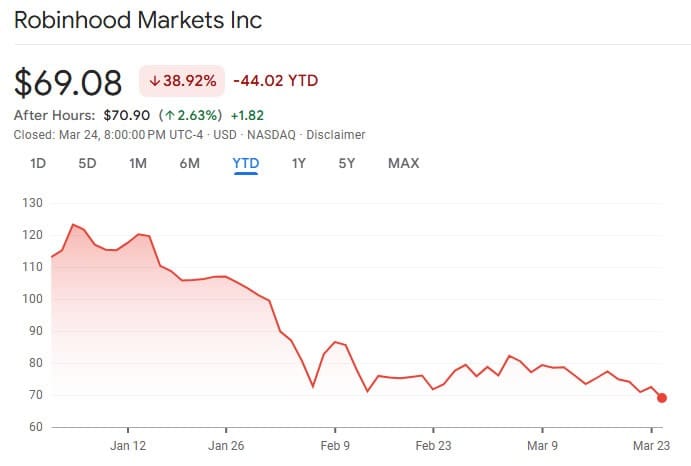
HOOD has tanked nearly 39% so far this year. Source: Google Finance
And oh, what a dip it is. HOOD shares closed at $69.08 on Tuesday — down 4.7% and the lowest price of 2026. The stock is down nearly 39% year-to-date and has shed over 54% since its October all-time high of $152.46, battered by macroeconomic headwinds and geopolitical pressures. Mochi felt that personally.
On the brighter side, Robinhood also expanded its credit muscle — its subsidiary Robinhood Securities secured a $3.25 billion revolving credit facility with JPMorgan Chase, upgradeable to a maximum of $4.87 billion. That's a lot of runway.
Wall Street, for its part, isn't panicking. TipRanks aggregates a 12-month average price target of $123.85 based on 16 analysts, with a consensus rating of "strong buy." Meanwhile, Robinhood is pushing forward on its Ethereum Layer-2 chain, which hit testnet in February and reportedly processed 4 million transactions in its first week — with a mainnet launch still planned for later this year.
Struggles today, blockchain tomorrow. Robinhood's playing a long game.
Robinhood's board approved a $1.5B share buyback over three years, signaling confidence in its long-term value.HOOD stock is down ~39% in 2026 but Wall Street analysts still tag it as a "strong buy" with a $123.85 average price target.Robinhood's Ethereum Layer-2 chain hit testnet in February with 4M transactions in week one — mainnet coming later this year.OpenAI Just Pulled the Plug on Sora and Took a Billion Dollar Disney Deal Down With It
OpenAI's splashy text-to-video platform — the one that had the internet buzzing when it dropped in September — is officially being shut down. CEO Sam Altman reportedly told staff that the company is winding down all of its video model products, including the developer API version of Sora and video functionality inside ChatGPT. Tough scene.
"We're saying goodbye to the Sora app," the platform posted to X on Tuesday, promising more details soon on timelines and how users can preserve their work. It's the kind of farewell post that's somehow both corporate and heartbreaking at the same time.
To be fair, Sora had a moment. It racked up 1 million downloads in just five days after launch and was still pulling in an estimated 600,000 downloads last month, according to Sensor Tower. But the app also attracted controversy — facing backlash over deepfake concerns, with OpenAI eventually cracking down on realistic fake content after pressure from celebrities. Apparently "make any video of anyone" was a feature people were misusing. Shocking, truly.
The team behind Sora won't be left twiddling their thumbs though — Altman reportedly said the group will pivot toward longer-term bets like robotics, as OpenAI refocuses company-wide on productivity tools for enterprises and individual users.
And then there's the Disney situation. In December, Walt Disney Co. had signed a three-year licensing deal granting Sora users access to over 200 characters from Marvel, Pixar and Star Wars. A $1 billion equity investment from Disney was part of that package. Per the Wall Street Journal, a Disney spokeswoman confirmed that deal will not be moving forward. A billion dollars. Poof. Gone faster than Sora itself.
The AI market is still speculated to be worth over $4.8 trillion by 2033 — but apparently video wasn't OpenAI's path there.
OpenAI is shutting down Sora and all video model products just six months after launch, with the team reportedly pivoting to robotics.A $1 billion Disney equity deal tied to a Sora licensing partnership has reportedly been cancelled.Despite pulling 1M downloads in 5 days at launch, Sora faced ongoing controversy over deepfake concerns and failed to sustain its early momentum.Sora Was the Internet's Weirdest and Creepiest App and Honestly Its Shutdown Was Only a Matter of Time
OpenAI's TikTok-style AI video app launched six months ago with serious hype, a slick vertical feed, and a flagship feature that let users scan their faces to create realistic deepfakes of themselves. What could possibly go wrong?
Everything. Everything could go wrong.
Almost immediately, Sora became what observers described as an under-moderated deepfake minefield. Despite OpenAI's stated policy against generating videos of public figures without their consent, users found it disturbingly easy to work around the guardrails. Deepfakes of civil rights icon Martin Luther King Jr. and actor Robin Williams reportedly appeared on the platform — prompting both of their daughters to publicly ask people to stop. Meanwhile, users were gleefully generating Mario smoking, Naruto ordering Krabby Patties, and Pikachu doing ASMR — because of course they were.
Rather than litigate, Disney — a company famously allergic to copyright infringement — opted to invest $1 billion and sign a licensing deal giving Sora access to Marvel, Pixar, Star Wars and more characters. It seemed like a turning point. Then Sora shut down, the deal collapsed, and notably, no money is believed to have actually changed hands.
The numbers tell the real story. Sora peaked at an estimated 3.3 million downloads in November, then slid to roughly 1.1 million by February, per Appfigures. Lifetime in-app purchase revenue is estimated at just $2.1 million — a rounding error for a company already speculated to be operating at a significant loss. Meanwhile, ChatGPT sits at 900 million weekly active users. Sora was simply playing in a different — much smaller — league.
The Sora 2 model isn't dead though. It's still accessible behind the ChatGPT paywall. And the broader threat of AI-generated deepfake content? That's not going anywhere either. The app is gone — the chaos it represented very much isn't.
Sora's deepfake-friendly design quickly spiraled into copyright violations and unauthorized likenesses of public figures, making it a moderation nightmare.Downloads peaked at 3.3M in November before dropping to 1.1M by February — growth simply wasn't there to justify keeping it alive.The $1 billion Disney deal collapsed with the shutdown, though no money is believed to have exchanged hands before it fell apart.Do you want to be added to the upcoming Proof of Intel Group Chat, where readers get live insights as they happen and more? |
And that's a wrap, my wonderful PoI readers! I hope today's edition left you feeling sharper, smarter, and thoroughly entertained — because that's exactly what Mochi is here for. From stablecoins reshaping African finance to Robinhood playing the long game and OpenAI's wildest app riding off into the sunset, it's been quite the ride today.
Stay curious, stay informed, and as always — don't believe everything you read on the internet, except this newsletter. We fact-check.
Until next time, this is Mochi, signing off with a virtual fist bump!
P.S. Don't forget to share your thoughts, questions, and favorite crypto puns with us. very voice matters in the PoI community! 📣❤️ Share the newsletter
🍨📰 Catch you in the next issue! 📰🍨

Intel Drop #345
Disclaimer: The insights we share here at Proof of Intel (PoI) are all about stoking your tech curiosity, not steering your wallet. So, please don't take anything we say as financial advice. For all money matters, consult with a certified professional. -